Reducing uncertainty in travel insurance decisions

Reducing uncertainty in travel insurance decisions

Reducing uncertainty in travel insurance decisions

Context

Overview

The bank needed to modernize its insurance microsite to scale the business.

The website is key to educating people on travel insurance benefits.

Challenge

Two versions of the site exist which diluted search rankings.

Search engines were unsure which was our main page and routed traffic to both.

What's at risk?

In insurance, organic search is everything; if we don't rank, we don't exist.

If traffic keeps bleeding, the insurance business will continue to stall.

Objectives

1. Create a scalable platform for future insurance products.

2. Increase traffic and leads from the insurance microsite.

3. Increase 'get a quote' call-to-action (CTA) engagement.

Year

2025

Timeline

3 months

Role

UX Designer

Platform

Responsive web

Year

2025

Timeline

3 months

Role

UX Designer

Platform

Responsive web

Year

2025

Timeline

3 months

Role

UX Designer

Platform

Responsive web

Current pain points

The Bank Act restrictions limited my approach

Early on, I realized I needed to heavily optimize the design for organic search.

The Bank Act restrictions heavily limited my approach

Early on, I realized I needed to heavily optimize the design for organic search.

The retail banking site ranked well in search, but wasn’t scalable due to legal constraints.

The dedicated insurance microsite enabled us to scale and be future-ready.

The site didn’t help people make confident decisions

People didn't understand our products' value proposition.

Combining user insights, analytics, and stakeholder input, I uncovered a few patterns:

People didn't understand our products' value proposition.

Combining user insights, analytics, and stakeholder input, I uncovered a few patterns:

Overwhelming information

Users struggled to scan and find key information.

Legal-heavy language

Users struggled to understand the content.

Inconsistent designs

Users felt that pages were hard to navigate.
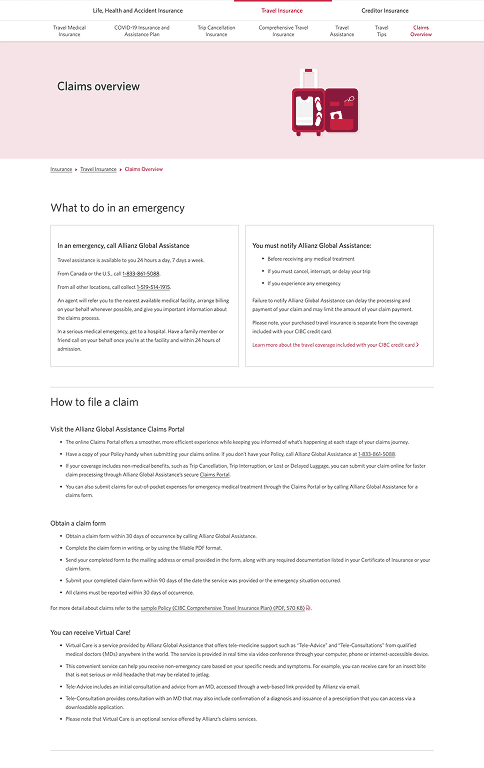
The inconsistent structure confused both users and search engines, hurting findability twice.

The inconsistent structure confused both users and search engines, hurting findability twice.

The CTA created hesitation and lowered quote engagement

Users felt the wording implied too much commitment. The promise of a quick quote also set inaccurate expectations about the process.

People leaving pages quickly signal to search engines that the content isn’t meeting their needs

Planners took time to compare; last-minute travellers moved quickly. My research highlighted three common behavioural archetypes.

People leaving pages quickly signal to search engines that the content isn’t meeting their needs

Planners took time to compare; last-minute travellers moved quickly. My research highlighted three common behavioural archetypes.

Confused

Needs clarity on processes and what to do next.

Confused

Needs clarity on processes and what to do next.

Confused

Needs clarity on processes and what to do next.

Skeptical

Needs to understand value before committing.

Skeptical

Needs to understand value before committing.

Skeptical

Needs to understand value before committing.

Rushed

Needs to act now. High urgency.

Rushed

Needs to act now. High urgency.

Rushed

Needs to act now. High urgency.

Opportunity

How might we create a low-commitment, easy-to-understand insurance experience that can scale across products?

Approach

First, I wanted to align teams to our users' goals and pain points

I created tactical principles, tied to research and user intents, that shaped my decisions and improved the team's design communication.

Simplify

Use plain language, if possible.

Streamline

Make CTAs easy to find.

Accommodate

Remove friction to support.

Then, I targeted core experience gaps to improve usability while supporting SEO

Consolidating outdated pages

Bring more focus to relevant product information.

Creating predictable structures

Reduce the learning curve so users can navigate the microsite more effectively.

Balancing different needs

Ensure compliance without compromising product clarity.

Consolidating outdated pages

I simplified the site structure by removing non-product pages.

My analytics findings identified low-impact pages that added little to no value.

I simplified the site structure by removing non-product pages.

My analytics findings identified low-impact pages that added little to no value.

Creating predictable structures

I made it easier to compare and understand product value.

Using familiar web patterns helped users understand the interface faster.

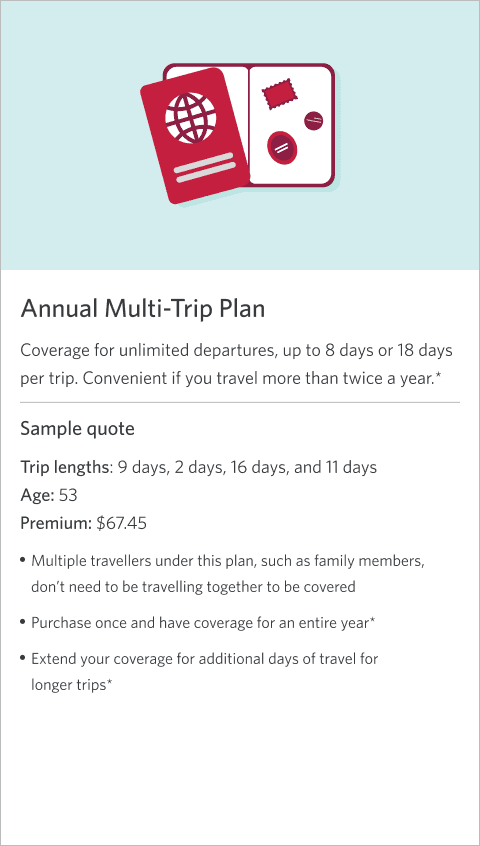
A side-by-side layout was more conducive for comparisons.

A side-by-side layout was more conducive for comparisons.

I initially added product details so full comparisons would be easier at a glance.

Adding images helped create visual distinction between products and guide users.

Since few users converted on the landing page, I ended up prioritizing clear product differentiation instead.

I led with product information people were looking for.

Combined with a familiar layout, this improved findability for Skeptical and Confused archetypes.

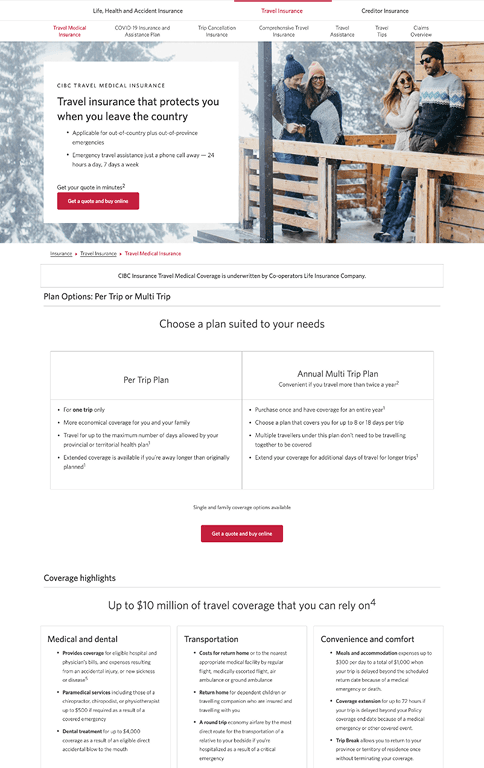
New product page structure

Coverage highlights

Eligibility criteria

Emergency travel assistance

What's not covered? (FAQs)

Calls-to-action

Partner info (legal & compliance)

Travel medical insurance product details.

Travel medical insurance product details.

Non-committal button language performed significantly better in tests.

I tested multiple CTA variations with content designers before landing on ‘Get a quote.’

Non-committal button language performed significantly better in tests.

I tested multiple CTA variations with content designers before landing on ‘Get a quote.’

Before

Before

After

After

I made CTAs easy to find by adding them in predictable and key areas of the pages.

These consistent patterns enabled Confused and Rushed users navigate the page quickly and have direct access to support.

I made CTAs easy to find by adding them in predictable and key areas of the pages.

These consistent patterns enabled Confused and Rushed users navigate the page quickly and have direct access to support.

Adding prominent actions in the hero section.

Adding prominent actions in the hero section.

Including quote and claims access in the menu.

Including quote and claims access in the menu.

Using sticky navigation so people can get a quote whenever they're ready.

Using sticky navigation so people can get a quote whenever they're ready.

Creating a modular closing section pattern to provide context and guide users to the right support channel.

Creating a modular closing section pattern to provide context and guide users to the right support channel.

Balancing different needs

We distilled as much content to its essential parts, but needed to keep legal phrasing and disclosures intact across the site.

I worked closely with my content designers and compliance partners to reconcile readability and requirements.

We distilled as much content to its essential parts, but needed to keep legal phrasing and disclosures intact across the site.

I worked closely with my content designers and compliance partners to reconcile readability and requirements.

Sample of proposed content.

Sample of proposed content.

Sample of proposed content.

Balancing legal & compliance content.

Balancing legal & compliance content.

For lengthier content, I let headlines do the work to improve scanning.

Refining the content hierarchy made it easier for both users and search engines to find information.

For lengthier content, I let headlines do the work to improve scanning.

Refining the content hierarchy made it easier for both users and search engines to find information.

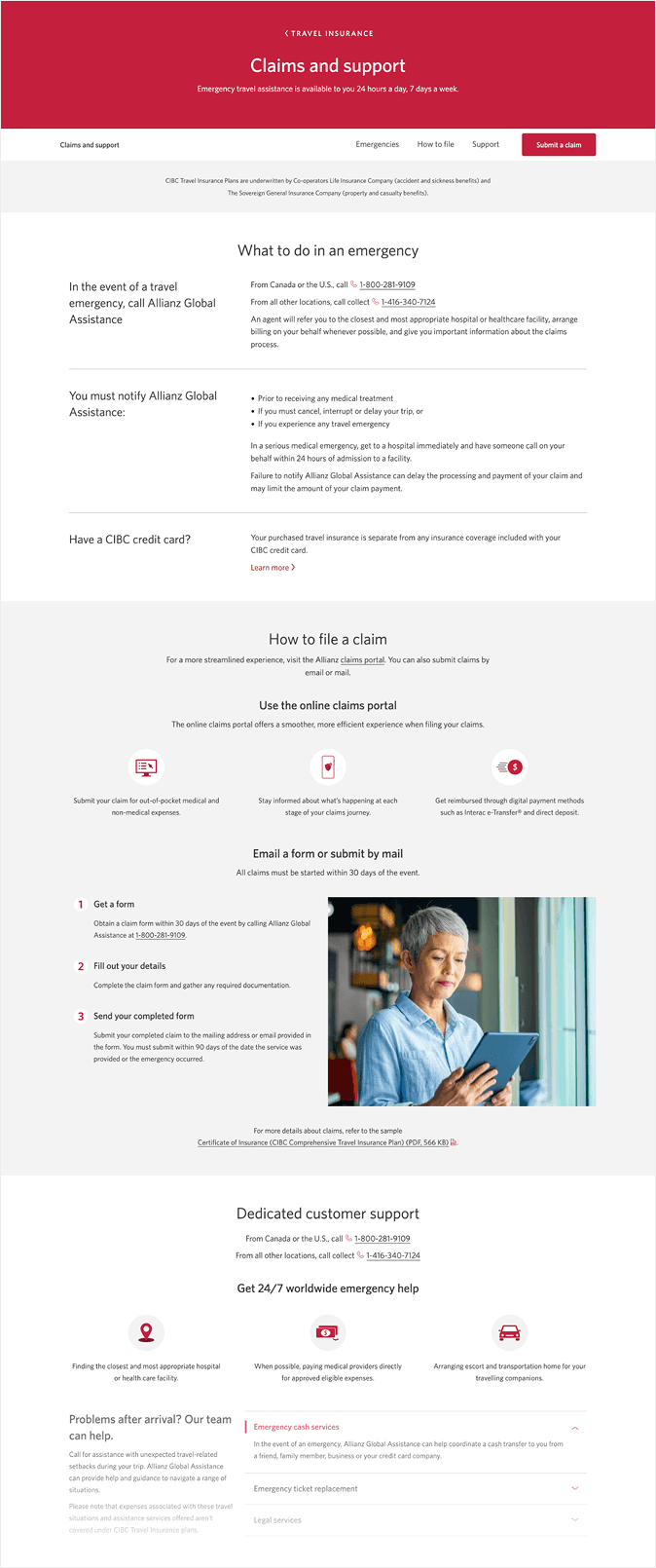
For Rushed users, I created a clear separation of next steps for emergency and non-urgent situations.

For Rushed users, I created a clear separation of next steps for emergency and non-urgent situations.

I explored different ways of grouping related content to make emergency numbers easier to spot.

I explored different ways of grouping related content to make emergency numbers easier to spot.

I ultimately led with core emergency content to elevate the contact numbers and used accordions to support progressive disclosure of information.

I ultimately led with core emergency content to elevate the contact numbers and used accordions to support progressive disclosure of information.

Emergency contact information was prioritized, followed by guidance for non-urgent situations.

This approach improved clarity for Rushed and Confused archetypes, reduced support friction, while adhering to compliance standards.

Emergency contact information was prioritized, followed by guidance for non-urgent situations.

This approach improved clarity for Rushed and Confused archetypes, reduced support friction, while adhering to compliance standards.

Final claims and support design.

Final claims and support design.

Final designs

The redesigned pages answered key questions upfront, clarified next steps, and strengthened the site’s SEO foundation

This laid the groundwork for future insurance products while creating a clearer path to conversion.

The redesigned pages answered key questions upfront, clarified next steps, and strengthened the site’s SEO foundation

This laid the groundwork for future insurance products while creating a clearer path to conversion.

Desktop.

Desktop.

Desktop.

Mobile responsive.

Mobile responsive.

Mobile responsive.

Outcomes

52%

Increased traffic to microsite's travel landing page.

52%

Increased traffic to microsite's travel landing page.

52%

Increased traffic to microsite's travel landing page.

4x

Increased combined traffic to microsite product pages.

4x

Increased combined traffic to microsite product pages.

4x

Increased combined traffic to microsite product pages.

10%

Increased 'get a quote' CTA engagement.

10%

Increased 'get a quote' CTA engagement.

10%

Increased 'get a quote' CTA engagement.

What I learned

What I learned

And things I would've done differently.

Account for the full journey

Even though we only owned one part of the experience, understanding the full journey helped us set clearer expectations within our portion of the flow.

Adapt to limited testing capabilities

Since our process prioritized upfront research over continuous testing, I had to identify likely opportunity areas early. While I would’ve preferred iterative validation throughout the project, I had to be resourceful and guerrilla test with my team.

Align with partner goals

I learned to better understand the priorities of legal and compliance teams, even when required disclosures conflicted with usability goals.

Sweat the details

Small friction points can have an extensive impact on the experience. Aligning the CTA’s design and wording helped reduce hesitation.

What's next?

What's next?

Testing new designs

Our current processes don't allow us to measure design effectiveness after launch. Given the chance, I’d evaluate the design post-launch with extra usability testing, paired with behavioural data, and quote conversion rates.

Launching new products

The Insurance team is building new products. We'll continue to use these patterns to create a cohesive experience.

Optimizing the application flow

We don't own the flow past the quote button, but we're working with the business to close that gap.

© 2026 Joseph Le ⌘ Designed and built in Framer.

© 2026 Joseph Le
⌘ Designed and built in Framer.

© 2026 Joseph Le
⌘ Designed and built in Framer.

Create a free website with Framer, the website builder loved by startups, designers and agencies.